Opening at Gallery VER, Bangkok, on 24 October 2026 to mark the gallery’s 20th anniversary, Jinjoon Lee’s solo exhibition The Sacred Mountain asks what we hold sacred, and how we might sustain our relationship with nature and with machines, in an age when AI treats even the human mind and memory as things to be decoded and reconstructed.
The exhibition brings together the artist’s daily breath, hands that burn and polish driftwood, a machine that repeats a ritual, sound generated by a model built on the connectome of a fruit fly, and a mountain remembered from the artist’s childhood hometown. Audiences walk into a symphony orchestrated by the artist and become part of it. Through this encounter, the artist asks what meaning our art holds as we seek to shape and protect the sacred in the era of AI.
In Thailand, where the exhibition takes place, Mount Sumeru stands at the centre of the Buddhist cosmos. The meru (เมรุ), the crematorium of a Thai temple, is named after this mountain, and Thai funerals traditionally conclude in fire. Charred driftwood gathered in Thailand is placed alongside a mountain burning on screen, while a machine repeats the gestures of mourning.
When a machine performs the gestures of ritual, is the longing within them transmitted? When a vanished landscape is regenerated, where does the time lived there persist? As resolution effaces mystery, where does the sacred dwell? Can art still set us free, and can nature still save us?


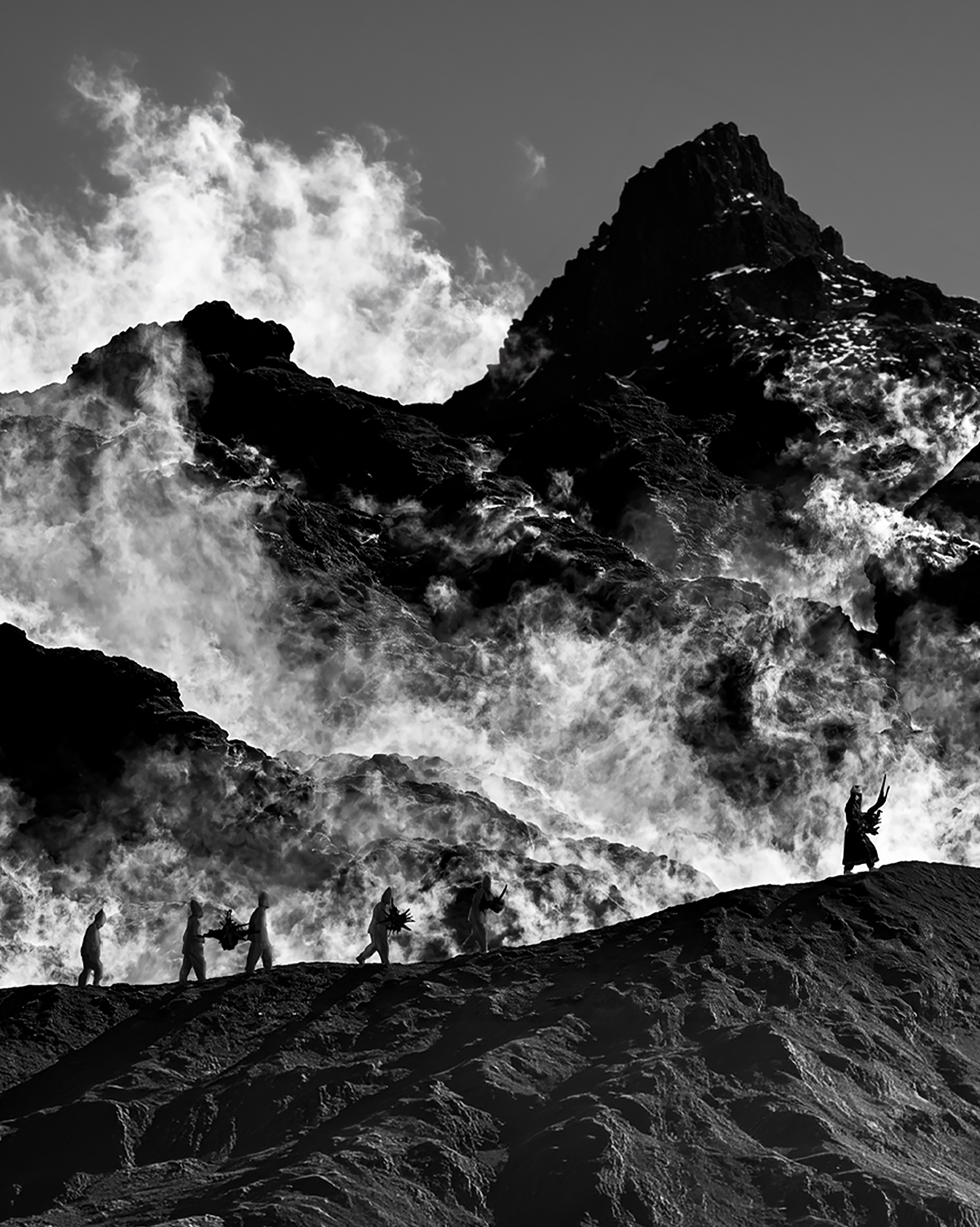
The Sacred Mountain, 2026. Single-channel 4K video, black-and-white, short film, sound, 31 min 23 sec.
The Sacred Mountain
The route of the pilgrimage follows the sixteenth-century Fuji Pilgrimage Mandala of Japan’s Muromachi period, which depicts the pilgrim’s way up Mount Fuji. But the pilgrims in this film are not human. A figure with a veiled face dismounts from a white horse and climbs the stairs. It drinks the mountain reflected in a teacup, breaks the cup and reads the cracks. It passes through a hall of mirrors and between totem poles; masked figures dance beneath the stars. They enter the water, beat drums, and antlered figures offer rites before a landscape screen. Arrows are shot, and the trees grow larger at their wounds, until every tree is felled, piled and burned. Figures carrying charred driftwood climb a snow-covered peak. At the summit wait a snake, a rooster and a pig: the three beasts that bite each other’s tails at the centre of the Wheel of Life, greed, hatred and delusion. The mountain erupts, the mountain burns, and the stage on which the mountain was built burns with its lights. The last image is the burning mountain reflected in water.
The movements of the beings in the film are subtly awkward. Bowing, dancing, drumming, climbing: every motion is calculated, and each movement looks different but is in fact the same motion repeated. The individual differences that belong to humans disappear, and in these bodies that perform every human rite without omission, only the plausibility stands exposed.


An AI-generated image holds two things at once: the ability to make anything look plausible, and a strangeness that sits slightly off within that plausibility. The film exposes both instead of hiding them. Scenes almost connect and do not; the edges of the stage, the lighting rigs and the camera rails are left visible, as in a record of a performance; and the black and white strips away the gloss, leaving only form, light and strangeness. The film draws on Parajanov, who told a whole life in frontal tableaux (The Color of Pomegranates, 1969); on Jodorowsky, who revealed the camera at the end of the pilgrimage (The Holy Mountain, 1973); on Kurosawa, who joined scenes by the logic of dreams (Dreams, 1990); and on Méliès, who made the first illusions the year after cinema was born (The House of the Devil, 1896). In the history of cinema, the first special effects were tricks the audience watched knowing they were tricks.
Does reverence require a body? Can that which does not die bow its head before death? When a bodiless being kneels before a mountain, is it a rite or an imitation? Is a being without the three poisons of Buddhism, the greed, hatred and delusion that the pig, the snake and the rooster stand for, liberated, or was it never a sentient being at all? Reverence belongs to those who have something to lose. When a machine performs a human rite again, is the longing within it carried over as well? The film does not answer; it watches until the mountain has burned to the end. The event repeats. But as on a morning after a night of flicking through short videos, we may have seen a great deal and yet not truly watched a single scene.


The Sacred Mountain Reference Book