
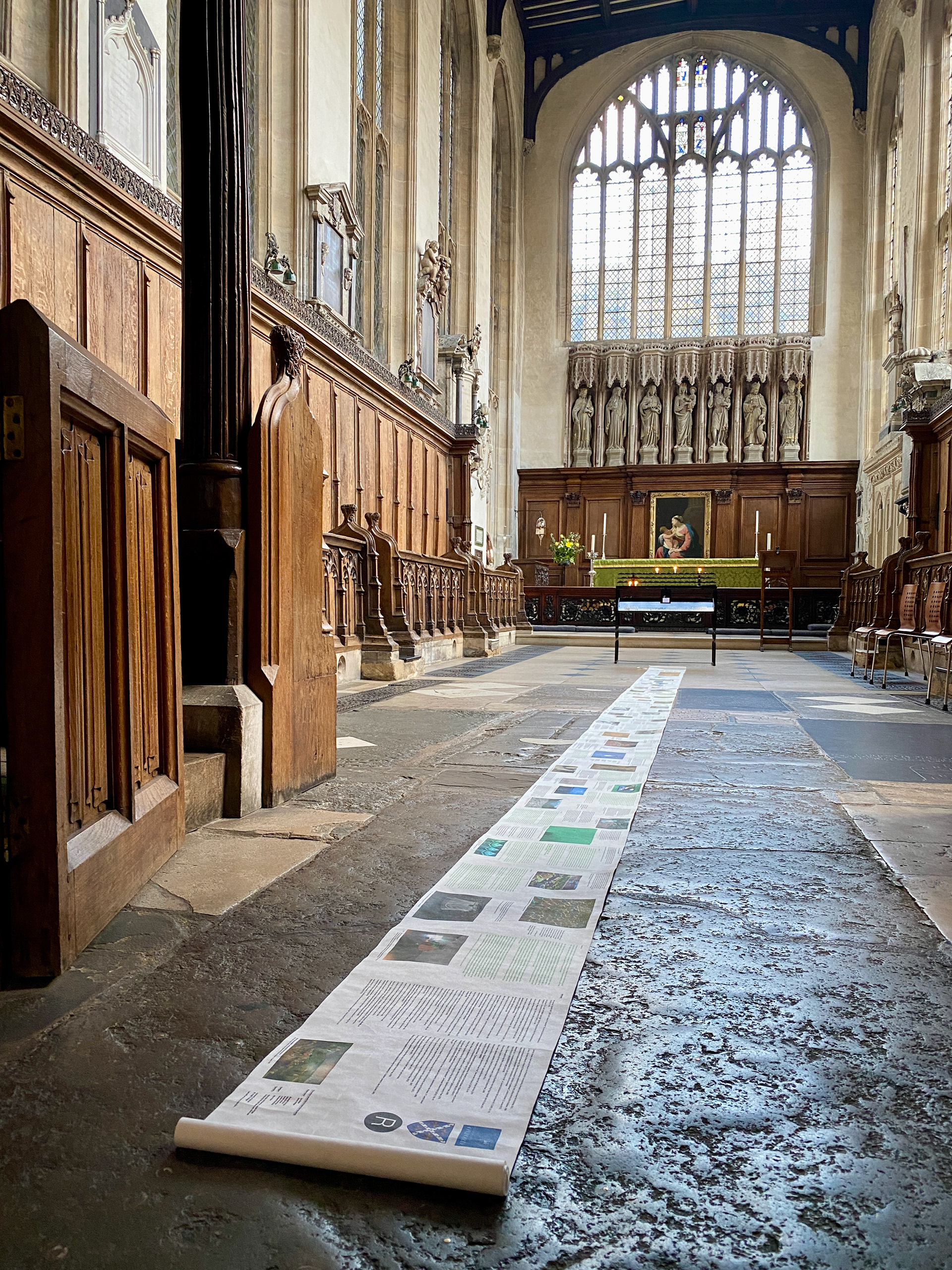
A ten-metre scroll doctoral thesis reinterpreting the 15th-century Joseon landscape painting scroll tradition, Empty Garden, exhibited at the University Church of St Mary the Virgin, Oxford, founded in the 15th century. 2020.
Empty garden : A liminoid journey to nowhere in somewhere
Empty Garden argues that the East Asian garden is not a representation of nature but a philosophical proposition: a space designed to produce what Victor Turner calls the liminoid, an optional, non-obligatory threshold experience that suspends the self between here and elsewhere, between the known and the not-yet-known. Where the liminal is ritual and obligatory, the liminoid is chosen and temporary; it opens rather than resolves.
This thesis proposes that the East Asian garden, through its structural principles of wandering, borrowed scenery (借景 jiejing), and constitutive emptiness, produces precisely this condition, and that certain works of contemporary art do so as well.
The thesis is presented as a ten-metre hanji scroll. This is not a formal conceit. The scroll enacts the argument it makes. 山水 Shanshui landscape painting refuses a single vanishing point; meaning is generated through multiple, shifting perspectives that resist resolution into one image. The scroll works in the same way. Letters, poems, scholarly footnotes, installation photographs, autoethnographic narrative, and poetic manifestos coexist on a single surface without hierarchy. None is illustration; none is centre.
The reader must move through the work bodily, must kneel, turn, follow, and in doing so enacts the very liminoid wandering the thesis describes. The form is the argument. What the Ashmolean holds in its collection is not a document that contains this argument. It is a body through which the argument moves.
The conceptual precedent for this formal strategy is 意園 Ui-won: the imaginary garden cultivated entirely within the mind, theorised by the eighteenth-century Joseon scholar 柳慶種 Yu Kyŏng-jong. Ui-won proceeds from the conviction that a garden held in imagination is more perfect than any garden built in the world, because the world's gardens cannot escape inconvenience and imperfection.
The space between imagination and reality is not a failure; it is a dwelling place. This thesis takes that proposition seriously. The gaps within the scroll, between image and text, between the personal and the philosophical, between East and West, are not failures of organisation. They are where the meaning lives.
This principle is enacted in the installation Green Room Garden, in which a live feed from NASA cameras aboard the International Space Station, the earth rolling in real time, is placed alongside pebbles arranged on chewing gum stains accumulated on an Oxford seminar room carpet. The cosmic and the abject, the infinite and the residual, occupy the same space without explanation.
This is the 華嚴 Huayan proposition made material: the entire world exists within a single particle, and every particle contains the entire world. A mountain can exist in a pebble. Or a grain of sand. Or a mountain.
Through critical engagement with three contemporary artists, the thesis tests its argument against living practice. Lois Weinberger plants immigrant weeds in abandoned railway tracks and disposable shopping bags, proposing that the best garden is one the gardener has relinquished: cultivation as letting go. Haegue Yang builds installations from blind slats and bells and artificial scent, constructing environments in which the senses are deliberately disoriented, belonging withheld. Tomoko Takahashi fills gallery spaces with accumulated urban debris until the viewer cannot find a position outside the work; there is only immersion. Each practice produces, by different means, the same condition the East Asian garden has always known: a self that cannot stand still, cannot fix its gaze, cannot remain certain of where it ends and the world begins. These artists do not illustrate the thesis. They confirm that the liminoid is not a historical concept. It is a living one.
The personal material in this thesis — a garden in Masan, a ruptured Achilles tendon in Oxford, a near-drowning at Shirahama, forty-nine days of mourning at a bhikkhuni temple — is not context for the argument. It is the argument. The philosophical and the autobiographical move as one, because the liminoid cannot be theorised from the outside. It must be passed through.
The hidden structural frame of the thesis is the Buddhist bardo: the forty-nine days between death and rebirth, through which my grandfather's soul travels and through which I, still living, also pass. The scroll has twenty-five letters. It is, in this sense, unfinished. The remaining movement is the reader's.
The thesis ends in two gestures. The final image is Pieter Bruegel's Landscape with the Fall of Icarus: the boy has fallen into the sea, and no one has noticed. The world continues.
Below it, a single sentence: I am still on my way to the Sun.
“I am delighted that the Ashmolean Museum has been able to acquire Dr Jinjoon Lee’s Empty Garden for our permanent collection. The long, contemplative scroll breaks new ground in so many ways: in the materials and techniques employed, in the breadth and depth of cultural and intellectual knowledge embedded in it, and in the complexity of the presentation of different spaces — all providing the viewer with multiple perspectives and experiences. Empty Garden is the first piece by a contemporary Korean artist to enter the collection; when not on display it will be available for viewing by appointment.”
Shelagh Vainker, Alice King Curator of Chinese and Korean Art, Ashmolean Museum, and Associate Professor of Chinese Art, University of Oxford

Dr Shelagh Vainker, Professor at the University of Oxford and Alice King Curator of Chinese and Korean Art at the Ashmolean Museum, reviewing the doctoral thesis Empty Garden in the Eastern Art Study Room, Ashmolean Museum. 2026.
What makes Empty Garden significant is not only what it argues but what it does to the form of argument itself. Practice-led doctoral research has long struggled with a structural contradiction: the work is the research, yet the thesis remains a document about the work, standing at one remove from it. Empty Garden refuses that distance. The ten-metre hanji scroll is simultaneously the artwork, the methodology, and the written submission. There is no separation between the thing being examined and the examination of it.
In doing so, I wanted this thesis to leave a precedent: that a doctoral candidate within an art school could present knowledge not as a commentary on practice but as practice itself, fully realised, bodily present, materially specific. The unanimous award of No Corrections by the examining committee was not simply a judgement on the quality of the argument. It was a recognition that this form of knowing is legitimate. That East Asian aesthetic philosophy, autoethnographic writing, personal grief, and installation art could constitute rigorous scholarly research when held together with sufficient precision and honesty.
In March 2026, the Ashmolean Museum's decision to acquire the scroll into its permanent collection completed what the examination committee first recognised: that what I made is not a record of thinking. It is thinking, held in a body, given a home.